
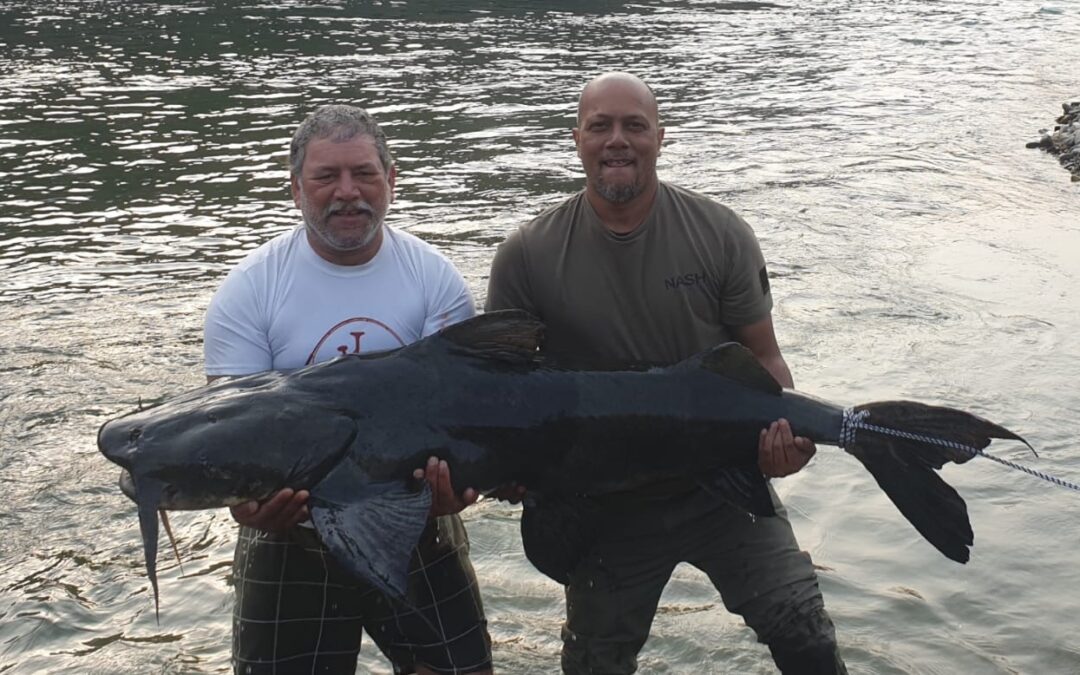
Blue catfish are also high on the list of targeted fish largely due to the extreme size they can reach. The world record of 143 pounds was caught on June 18, 2011 by Nick Anderson out of John Kerr Reservoir on the NC, Virginia border. This massive fish has a length of 57 inches and a girth of 47 inches. Indeed a monster fish. Because of these extreme sizes, many anglers who target catfish are doing so for the opportunity of hooking into these large beasts. Giant catfish of this size are estimated to be twenty years old or older. So many people are targeting these large fish that South Carolina recently instituted a size limit in the Santee Cooper lakes. Only one fish over 30 inches can be kept per day. This has really aided the survival of these trophy fish that may be decades old. As one biologist put it: “If we make a mistake in managing these giant fish, it could take a generation or more to recover.”
Blue catfish are predators and not scavengers per se’. They like to feed on fish, and live fish is a great bait for blues. They can and will eat other baits, and some have chosen to mix it up with these also. Chicken necks is a favorite among some, as is sausage, hot dogs, and shrimp. Cut bait is a personal favorite, specifically fish heads.
One guide I fished with recently who doesn’t want to be named said that without question his favorite bait is either white perch heads or crappie heads. (Note your local regulations on the use of game fish for bait). In our home state you are allowed to use gamefish for bait, but it counts towards your daily creel limit. These baits stay on your hook better and the bigger fish tend to like it.
Tackle for these big fish is big. A minimum of thirty pound braid is required with many opting for fifty pound braid with a 5/0 – 8/0 circle hook. These big fish need a big strong hook to hold them. I have even used 10/0 circle hooks when targeting giants. Drift fishing is a favorite method. Finding likely hiding places and allow the wind to push your bait through these holes. In the summer, blues can be found on the drop off of channels, and they move into the shallow flats at night. Some of the biggest fish have been caught in very shallow water of less than three feet.
Clayton Crawford a guide on Lake Moultrie likes to anchor for big cats. “I have good locations and look for the fish in these places. Then I anchor and cast out eight or ten rods all around the boat. If we don’t have a bite in thirty minutes, we move.” In the heat of the summer, Crawford likes to find some moving water, but not too fast: “A little current is best. It tends to keep the water more oxygenated and the bigger blues like that.” Crawford says.
It is pretty common to catch channel and blue cats in the same local. They are opportunistic feeders and will often share the feeding grounds. As with other species, fish of similar size swim together. So if you catch one twenty pounder, hang on because there could be a half dozen more in the same area.